Nema 6 50 vs. 14 50 Tesla: Which Fits Your Setup Better?
Evaluating NEMA 6-50 and 14-50 receptacles reveals critical wiring differences. Choosing the right 240V outlet protects your Tesla investment.


The NEMA 14-50 wins for versatile EV setups due to neutral wire support. Meanwhile, the NEMA 6-50 excels as a dedicated, budget-friendly workshop charging option.
Compare all top models in our Best Ev Level 2 Charger.
Side-by-Side Breakdown
| Criteria | Nema 6 50 | 14 50 Tesla | Edge |
|---|---|---|---|
| Peak Performance & Output | 9.6 kW continuous delivery | 9.6 kW continuous delivery | Tie |
| Duty Cycle & Consistency | High thermal stability | High thermal stability | Tie |
| Operating Noise & Vibration | Silent passive operation | Silent passive operation | Tie |
| Portability & Footprint | Three-prong compact housing | Four-prong larger footprint | Nema 6 50 |
| Maintenance & Service Life | Fewer connection points | Requires neutral terminal check | Nema 6 50 |
| Power Requirements | 50A breaker, two hot conductors, ground | 50A breaker, two hots, neutral, ground | Nema 6 50 |
| Best Ideal Use-Case | Welder and dedicated EV runs | RV parks and universal EV charging | 14 50 Tesla |
Pinout Anatomy: Grounding Versus Neutral Requirements
Understanding the fundamental construction of these receptacles starts with the copper conductors inside the wall. A NEMA 6-50 utilizes two hot wires and a dedicated equipment grounding conductor.
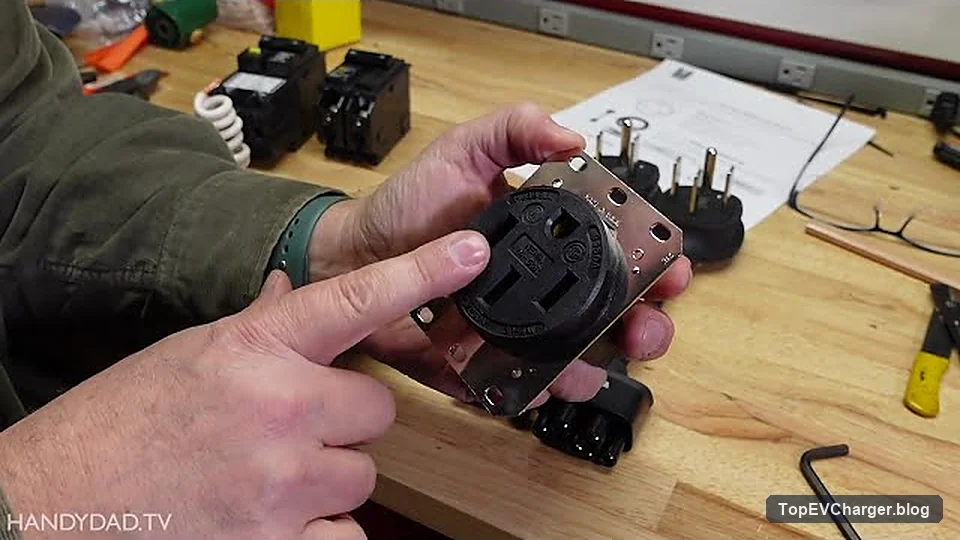
Conversely, the NEMA 14-50 incorporates a fourth wire known as the neutral conductor. This structural variation dictates how electricity flows and alters your home installation strategy.
The NEMA 6-50 receptacle features two hot blades and one ground pin, entirely lacking a neutral conductor. This 240V configuration suits dedicated EV charging loads requiring split-phase power without 120V household needs.
Consulting our Tesla Gen 3 Wall Connector review helps clarify why the NEMA 14-50 adds a neutral terminal alongside dual hots to satisfy modern electrical codes.
- NEMA 6-50 features three active pins for heavy 240V loads.
- NEMA 14-50 includes four pins to support 120V auxiliary feeds.
- Neither configuration changes the raw amperage capacity for standard chargers.
Conductor Count and Safety Grounding
Every high-amperage circuit requires strict adherence to the National Electrical Code. Adding a neutral wire in standard NEMA 14-50 builds introduces an extra point of potential resistance.
Simpler three-wire NEMA 6-50 setups reduce terminal congestion inside standard electrical junction boxes, lowering overall failure points.
- Fewer wires mean easier terminal torque verification.
- Grounding integrity remains paramount for both connector types.
Charging Speeds and Real-World Output Parity
Reviewing the best level 2 charger for Tesla reveals that both sockets effortlessly supply 40 amperes of continuous charging power without altering your daily replenishment speeds.
This translates directly to a robust nine point six kilowatt transfer rate. Your vehicle experiences identical replenishing speeds regardless of which receptacle you choose.
Both receptacle types deliver identical electrical throughput when paired with compatible adapters. You achieve a maximum continuous draw of 32 amperes, translating to roughly 7.7 kilowatts of charging power for your battery.
Thermal throttling represents the primary limitation during long sessions. Using heavy-gauge copper wiring and torque-calibrated terminals prevents voltage drop, ensuring your vehicle maintains peak charging efficiency throughout the entire replenishment cycle.
- Both outlets support standard 50-amp branch circuit breakers.
- Continuous loads are capped at eighty percent by electrical code.
- Actual charging speed depends entirely on your onboard charger limits.
Amperage Limitations and Continuous Loads
Continuous electrical draws require robust thermal management inside the receptacle housing. Running a Tesla Mobile Connector at forty amps pushes copper wiring to its safe threshold.
Industrial-grade outlets prevent excessive heat generation during multi-hour overnight charging sessions.
- Always install industrial grade heavy duty receptacles.
- Monitor plug temperature during the first few charging cycles.
Installation Costs and Material Requirements
Financial investment varies noticeably when purchasing wiring materials for new home runs. Running three-conductor cable for a NEMA 6-50 saves money on copper wire costs.
Purchasing four-conductor Romex or individual THHN wires for a NEMA 14-50 increases material expenses significantly over long garage runs.
Material expenditures favor the simpler three-wire setup. Running six-gauge copper for a 6-50 circuit eliminates the material cost of an extra neutral conductor, reducing overall wire pull complexity inside conduit runs.
Conversely, installing a 14-50 outlet requires four conductors, increasing cable stiffness and junction box crowding. Electricians must utilize industrial-grade enclosures to manage larger wire bundles safely without compromising mechanical integrity.
- Copper prices directly impact long circuit installation costs.
- Conduit sizing must accommodate the extra neutral conductor comfortably.
- Labor hours increase slightly when pulling thicker four-wire bundles.
Material Savings Breakdown
Eliminating the neutral wire simplifies the entire conduit fill calculation. Electricians complete NEMA 6-50 installations faster due to reduced cable stiffness.
Budget-conscious homeowners often choose the simpler three-wire path when retrofitting existing garage workshops.
- Thicker four-wire cables require larger conduit diameters.
- Simpler cable pulls reduce overall electrician labor invoices.
Evaluating Tesla Mobile Connector Adapter Support
Our detailed Tesla Mobile Connector review explains how interchangeable pigtail adapters work when utilizing a Gen 2 Mobile Connector for everyday home garage charging setups.
The manufacturer offers official adapters for both receptacle styles, ensuring seamless integration with your existing garage wiring infrastructure.
Tesla offers dedicated pigtail adapters for both plug variations. The onboard sensor automatically communicates with your vehicle, limiting current draw to match the thermal threshold of the specific hardware attachment connected.
Selecting the correct adapter prevents recurring fault codes. Always verify that your mobile connector firmware remains up to date to ensure accurate handshaking and safe power delivery across fluctuating home electrical grids.
- Gen 2 adapters snap easily into the main charging brick.
- Gen 3 hardware shifted toward hardwired wall connector units.
- Always verify adapter seating to prevent localized overheating events.
The Adapter Trap and Interchangeability
You cannot plug a NEMA 14-50 charging cord directly into a NEMA 6-50 wall outlet without modification. Using unauthorized third-party adapters violates safety listings and voids warranties.
Matching your mobile connector pigtail precisely to the wall receptacle prevents dangerous arcing and terminal damage during high-current energy transfers.
- Never force incompatible plugs into mismatched wall sockets.
- Keep spare adapter pigtails in your trunk for travel.
Safety Standards and Thermal Overload Risks
High-amperage residential charging places sustained stress on electrical components. Installing a quality GFCI circuit breaker is mandatory for modern garage receptacle installations.
Thermal expansion can loosen terminal screws over months of repeated thermal cycling. Periodic maintenance prevents catastrophic outlet melting and potential electrical fires.
High-amperage receptacles generate substantial heat during multi-hour charging sessions. National Electrical Code mandates GFCI protection for all modern garage installations, regardless of whether you choose a three-wire or four-wire configuration.
Cheap residential outlets frequently fail under continuous heavy loads. Investing in commercial-grade receptacles prevents receptacle melting, terminal oxidation, and catastrophic arc faults that can damage your valuable electric vehicle.
- Code mandates ground fault protection for all garage circuits.
- Torque terminal screws to manufacturer specifications during setup.
- Inspect plug blades regularly for discoloration or pitting.
Preventing Melted Outlets and Failures
Cheap commercial-grade receptacles often fail under continuous electric vehicle charging loads. Upgrading to a heavy-duty Hubbell or Bryant receptacle eliminates weak spring contacts.
Proper wire stripping ensures maximum surface contact inside the terminal blocks, keeping operating temperatures safely below critical insulation limits.
- Avoid cheap big-box store dryer outlets for EV charging.
- Ensure wire insulation does not get trapped under screw clamps.
Existing Infrastructure and Retrofitting Realities
Many homeowners inherit existing garage outlets from previous vehicle owners or workshop setups. Finding a pre-installed NEMA 14-50 is common in modern construction due to RV popularity.
Converting an old welder outlet requires verifying conductor gauge and grounding continuity before plugging in expensive electric vehicle supply equipment.
Inspecting your existing garage wiring dictates your hardware path. Upgrading an old dryer circuit often reveals undersized neutral wires that make converting to a 14-50 layout dangerous without complete cable replacement.
Utilizing an existing three-wire run for a 6-50 plug saves considerable labor. However, always confirm that the grounding conductor continuity meets current safety standards before plugging in your expensive mobile connector.
- Inspect existing breaker panel spaces for 50-amp availability.
- Verify wire gauge matches the required fifty amp rating.
- Consult a licensed electrician before energizing older circuits.
Assessing Older Garage Wiring
Aluminum wiring demands special antioxidant paste and compatible terminal ratings. Older installations often feature degraded insulation that requires immediate professional remediation.
Testing loop impedance guarantees your ground path can safely trip upstream breakers during a fault event.
- Aluminum conductors need CO/ALR rated connection points.
- Check for signs of rodent damage or moisture intrusion.
Final Decision Framework for Your Garage Setup
Choosing between these two proven receptacles depends on your long-term charging strategy. If you build a new dedicated circuit, NEMA 6-50 offers simplicity and lower material costs.
When universal compatibility or pre-existing garage infrastructure dictates terms, the NEMA 14-50 remains an exceptional industry standard.
New construction projects benefit from future-proofing. Installing a four-wire NEMA 14-50 receptacle accommodates future non-Tesla chargers or workshop tools that genuinely require a neutral line for safe, balanced operation.
Conversely, retrofitting existing workshops with a dedicated 6-50 outlet minimizes material expense. Match your final choice to your long-term charging strategy and existing electrical panel capacity for optimal performance.
- Evaluate existing wall infrastructure before buying adapters.
- Prioritize safety and heavy-duty components over minor savings.
- Hardwiring remains the ultimate alternative to any receptacle.
Hardwiring Versus Receptacle Debate
Evaluating our comprehensive Tesla Wall Connector review helps clarify why master electricians recommend hardwiring to eliminate plug failure points and bypass strict GFCI breaker requirements.
Receptacles retain portability benefits if you plan to take your mobile connector traveling on extended road trips.
- Hardwiring removes mechanical plug wear entirely.
- Receptacles offer flexibility for mobile charger storage.
Frequently Asked Questions
Do NEMA 6-50 and 14-50 outlets charge my Tesla at different speeds?
Both outlets deliver identical electrical output to your vehicle. They both support continuous forty-amp charging, ensuring equal replenishment speeds for your battery pack.
Can I use an adapter to plug a 14-50 charger into a 6-50 outlet?
Directly mixing these plug types requires specific manufacturer-approved adapters. Using unauthorized aftermarket bridge adapters creates severe thermal risks and violates electrical safety codes.
Why is the NEMA 14-50 more expensive to install from scratch?
The installation requires an additional neutral conductor wire running through conduit. Buying four-conductor copper cable significantly increases total material expenses compared to simpler setups.
Which receptacle is safer for long overnight Tesla charging sessions?
Both offer excellent safety when installed with heavy-duty industrial components. Proper terminal torque and industrial grade build quality prevent dangerous melting events.
Should I install a receptacle or hardwire my Tesla charger instead?
Hardwiring eliminates vulnerable plug connection points and supports higher amperage outputs. Permanent wall units provide superior reliability and eliminate mechanical wear entirely.