Nema 4X vs. Nema 3R Ev Charger Enclosure: Which Fits Your Setup Better?
Selecting the right outdoor enclosure protects your expensive EV charging investment against harsh weather. Understanding NEMA ratings prevents premature equipment failure during major seasonal storms.

Choose Nema 4X for coastal environments with high salt exposure. Opt for NEMA 3R in standard covered residential driveways where extreme weather rarely impacts electrical components.
Compare all top models in our Best Ev Level 2 Charger.
Side-by-Side Breakdown
| Criteria | Nema 4X | Nema 3R Ev Charger Enclosure | Edge |
|---|---|---|---|
| Peak Performance & Output | Unrestricted electrical throughput | Unrestricted electrical throughput | Tie |
| Duty Cycle & Consistency | Maintains rating under severe exposure | Standard rain and ice protection | Nema 4X |
| Operating Noise & Vibration | Silent solid-state electronics | Silent solid-state electronics | Tie |
| Portability & Footprint | Standard wall-mounted chassis | Standard wall-mounted chassis | Tie |
| Maintenance & Service Life | Extended lifespan in corrosive zones | Standard residential longevity | Nema 4X |
| Power Requirements | Compatible with 40A to 80A circuits | Compatible with 40A to 80A circuits | Tie |
| Best Ideal Use-Case | Marine, coastal, and chemical zones | Protected outdoor residential walls | Nema 4X |
Understanding Electrical Enclosure Standards
The National Electrical Manufacturers Association establishes rigorous protocols for industrial equipment protection. These ratings dictate how effectively enclosures safeguard internal electronics against moisture intrusion and airborne particulates.
Residential electric vehicle supply equipment relies heavily on these classifications. Choosing the correct rating ensures your charging hardware survives seasonal temperature swings and persistent precipitation without degrading.
Electrical enclosure ratings established by NEMA dictate how safely residential electric vehicle supply equipment handles environmental hazards, moisture ingress, and accidental physical impacts during routine garage or exterior driveway operations.
Reviewing standard UL 50E guidelines clarifies that rating classifications are not merely marketing terms but rigorous certifications verifying protection against rain, sleet, ice formation, and corrosive atmospheric agents over prolonged deployment.
- Standardized testing validates enclosure integrity.
- Environmental factors dictate your required rating.
- Protection levels vary drastically by numerical code.
- Standardized NEMA ratings define physical environmental protection levels.
- Third-party laboratory testing validates long-term outdoor operational reliability.
Key Differences in Protection Levels
Basic ratings focus primarily on falling rain and light sleet. Advanced industrial classifications introduce strict mandates for corrosion resistance and pressurized hose-down tolerance.
- Basic units handle rainfall only.
- Advanced models resist high pressure.
Regulatory Compliance Frameworks
National Electrical Code mandates specific ingress protection thresholds depending on whether charging hardware is installed indoors, under a protective carport, or exposed directly to prevailing winds and driving rain.
- Local jurisdiction codes take precedence over general manufacturer guidelines.
Decoding NEMA 3R Specifications Outdoors
A standard NEMA 3R enclosure is engineered primarily for outdoor use where rain, sleet, and external ice formation prevail. However, they lack comprehensive protection against windblown dust.
Most residential EV chargers feature this rating because driveways often offer partial overhead cover. They provide reliable seasonal defense while keeping manufacturing costs affordable for consumers.
NEMA 3R enclosures provide robust defense against falling rain, sleet, snow, and external ice formation, making them a popular, cost-effective choice for residential EV chargers mounted beneath standard eaves.
Because these housings feature bottom weep holes for condensation drainage, they are not completely airtight or watertight against directed hose streams, requiring careful site selection away from sprinkler systems.
- Shields against falling rain effectively.
- Vulnerable to fine windblown dust.
- Economical choice for sheltered spaces.
- Designed primarily for sheltered outdoor mounting locations.
- Internal condensation management prevents electrical short circuits.
Drainage Design Principles
Unlike sealed waterproof boxes, NEMA 3R units frequently incorporate internal drain paths. These engineered weep holes allow condensed moisture to escape before pooling near live electrical terminals.
- Weep holes prevent dangerous pooling.
- Vented designs manage internal humidity.
Drainage and Ventilation Design
Weep holes allow trapped ambient moisture to escape naturally, preventing internal humidity accumulation during rapid daily temperature swings in humid residential environments.
- Clearance around drainage ports must remain unobstructed.
Evaluating Nema 4X Corrosion and Chemical Resistance
Stepping up to a Nema 4X rating brings exceptional defense against heavy splashing water and hose-directed streams. The designation also mandates extreme resistance to harsh chemical agents.
Constructed from heavy-duty polymers or marine-grade stainless steel, these units prevent rust formation entirely. This makes them indispensable for coastal homes facing high salinity environments.
Upgrading to NEMA 4X introduces advanced elastomer gasketing and corrosion-resistant materials like 304 stainless steel or specialized polycarbonate blends capable of withstanding harsh coastal salt fog environments.
This superior rating protects internal printed circuit boards and high-voltage contactors from windblown dust, splashing water, hose-directed streams, and aggressive chemical cleaners used in commercial parking structures.
- Delivers complete dust-tight sealing.
- Withstands aggressive saltwater spray.
- Utilizes premium stainless steel or polymers.
- Offers absolute sealing against driving rain and heavy washdowns.
- Resists chemical degradation from de-icing salts and road grime.
Marine and Industrial Deployments
Vehicle chargers installed near oceanfront properties endure relentless salt fog exposure. We recommend reviewing top options featured in our best ev level 2 charger guide for superior corrosion-resistant housing choices.
- Ocean air accelerates metal oxidation.
- Stainless enclosures block salt damage.
Material Selection Criteria
Selecting stainless steel variants prevents pitting corrosion in marine installations where airborne chloride concentrations accelerate standard metal alloy surface degradation.
- Polymeric compounds offer superior impact resistance in cold weather.
Real-World Weatherproofing Performance Benchmarks
Severe thunderstorms test the gasket integrity of every outdoor electronics cabinet. Rubberized seals must compress uniformly to prevent capillary action from drawing moisture inward during driving rains.
Laboratory tests subject these enclosures to oscillating water jets simulating extreme weather. Units earning higher certifications demonstrate zero internal fluid accumulation during prolonged high-pressure evaluations.
Field evaluations demonstrate that gasket compression degrades over time under extreme ultraviolet radiation, necessitating annual visual inspections of door seals to maintain the rated weather barrier integrity.
Thermal cycling causes expansion and contraction stresses across plastic latches and hinge points, which can compromise lower-tier enclosure seals if fasteners are not torqued to manufacturer specifications.
- Gasket compression ensures watertight seals.
- Simulated rain tests prove durability.
- Wind-driven precipitation challenges basic housings.
- Gasket maintenance preserves the original ingress protection rating.
- Hardware torque checks prevent seal distortion over years of use.
Long-Term Seal Degradation
Continuous exposure to direct sunlight hardens rubber door gaskets, reducing their ability to rebound and seal against wind-driven moisture during severe winter storms.
- Silicone-based protectants extend elastomer flexibility significantly.
Thermal Management and Solar Heat Gain
Enclosure color and material composition directly influence internal operating temperatures during peak summer months. Direct sunlight causes dark plastic chassis to absorb significant thermal energy rapidly.
Excessive heat forces EV chargers to throttle their maximum charging amperage to protect internal components. Proper thermal dissipation prevents premature thermal shutdown during high-capacity overnight charging sessions.
Dark-colored NEMA 4X polymer enclosures absorb significant solar heat gain during peak summer afternoons, which is evaluated thoroughly in our detailed emporia level 2 ev charger review.
Unlike ventilated NEMA 3R models that allow passive airflow, sealed NEMA 4X units rely entirely on conductive heat dissipation through the chassis mounting plate to manage internal temperatures safely.
- Direct sunlight increases internal stress.
- Thermal throttling protects internal circuitry.
- Material reflectivity impacts operating temperatures.
- Direct sunlight exposure raises internal operating temperatures considerably.
- Proper shading preserves charging speeds during intense heatwaves.
Heat Dissipation Mechanics
Conduction plates transfer heat away from power electronics, ensuring the onboard computer avoids thermal shut downs while delivering maximum amperage to your electric vehicle.
- Mounting location orientation dictates direct solar exposure duration.
Installation Constraints and Mounting Details
Correct wall mounting remains critical for maintaining the weather resistance of your outdoor hardware. Installers must use bottom-entry conduit fittings to prevent water from running down supply cables.
Drip loops on incoming power lines stop moisture from migrating directly into electrical knockouts. Ignoring these fundamental mounting protocols instantly voids most manufacturer enclosure warranties completely.
Proper installation requires utilizing bottom-entry conduit hubs with rated sealing washers to prevent moisture migration along electrical feeder cables entering the bottom of the enclosure.
Wall-mounting brackets must maintain a slight clearance gap behind the enclosure chassis to prevent trapped moisture from rotting exterior wood siding or corroding masonry anchor fasteners.
- Bottom conduit entry stops leaks.
- Drip loops redirect running water.
- Proper torque maintains seal integrity.
- Bottom cable entry stops gravity-fed water infiltration completely.
- Standoff spacers promote airflow behind the mounting surface.
Conduit Routing Best Practices
Avoiding top conduit entries eliminates pathways for water leaks. Selecting units featured in our best 240v ev charger roundup ensures proper gasket sealing and optimal long-term electrical safety.
- Sealing compound on threaded fittings adds secondary moisture defense.
Hardwired Versus Plug-In Outdoor Configurations
Hardwired EV chargers eliminate outdoor receptacle vulnerabilities entirely by hard-connecting internal wiring. This configuration pairs exceptionally well with robust weather-resistant enclosures for maximum safety.
Outdoor 240-volt outlets require heavy-duty weatherproof covers to prevent arcing during storms. Utilizing a hardwired setup removes a major point of electrical failure in wet climates.
Hardwired EV charger setups eliminate vulnerable plug connections, reducing water ingress points when using options highlighted in our best level 2 charger for jeep 4xe guide.
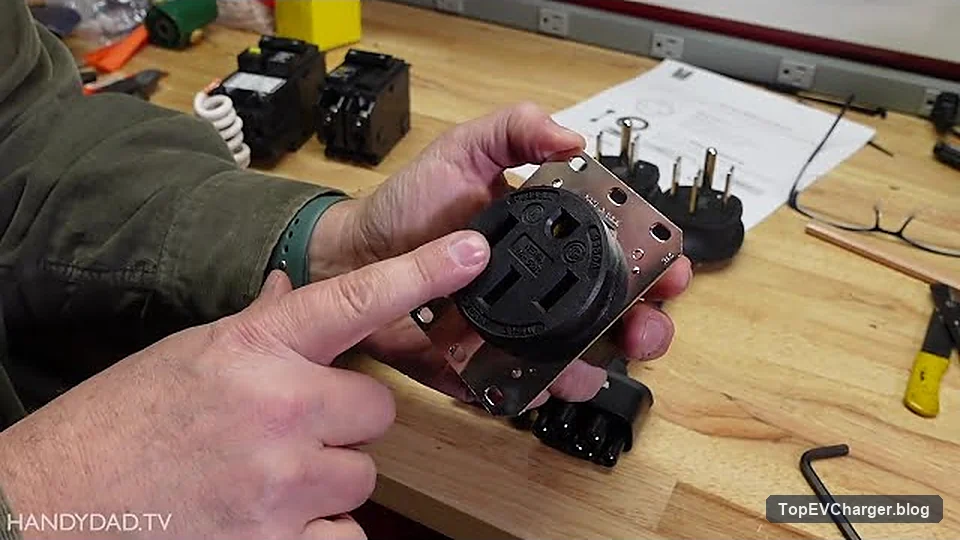
Outdoor NEMA 14-50 receptacles utilized for plug-in chargers require dedicated weather-resistant while-in-use covers that often exceed standard enclosure footprints and demand careful architectural clearance planning.
- Hardwiring eliminates plug points.
- Outdoor receptacles need heavy covers.
- Permanent connections improve storm safety.
- Hardwiring removes external high-amperage plug failure points.
- Plug-in units demand heavy-duty weatherproof receptacle covers.
Receptacle Protection Challenges
Heavy feeder cords exert constant downward leverage on outdoor outlets, requiring locking enclosures to prevent cover distortion during wet and windy weather conditions.
- Strain relief clamps protect receptacle terminals from mechanical pull.
Frequently Asked Questions
Is a NEMA 3R charger safe to install in direct unshaded sunlight?
While standard units function outdoors, extreme heat can trigger thermal throttling and reduce charging speeds significantly. You should mount them on north-facing walls whenever possible to avoid solar damage.
Do coastal installations demand superior protection against the elements?
Coastal installations demand superior protection because salt fog accelerates metallic corrosion rapidly. Investing in a marine-grade housing prevents premature electrical failure and extends your hardware service life.
Do I need professional assistance to seal cable entry points during setup?
Yes, technicians must use rated compression fittings to maintain waterproof integrity and preserve your manufacturer warranty coverage during the initial hardware installation process.
Can heavy rain penetrate a standard residential enclosure during severe storms?
Wind-driven precipitation can bypass basic louvers, making a sealed cabinet necessary for completely exposed mounting locations lacking any overhead structural protection.
What causes internal condensation inside a sealed outdoor electrical cabinet?
Temperature differentials between day and night create moisture inside the box, which is why proper drainage channels or specialized breathers remain essential.