Nema 14 50 vs. Hardwired: Which Fits Your Setup Better?
Choosing between a plug-in NEMA 14-50 outlet and a permanent hardwired EV charger involves critical electrical safety trade-offs, installation costs, and long-term charging speeds.


For maximum safety and continuous 48-amp output, hardwired installation is the undisputed winner for everyday residential EV charging.
Compare all top models in our Best Ev Level 2 Charger.
Side-by-Side Breakdown
| Criteria | Nema 14 50 | Hardwired | Edge |
|---|---|---|---|
| Peak Performance & Output | Capped at 40 amps continuous load | Delivers up to 48 amps continuous power | Hardwired |
| Duty Cycle & Consistency | Prone to thermal wear at receptacle contacts | Solid internal terminal blocks resist heat | Hardwired |
| Operating Noise & Vibration | Standard plug seating friction only | Zero mechanical vibration with torque-lug wiring | Hardwired |
| Portability & Footprint | Allows unit relocation or charger swapping | Permanent fixture tied to dedicated conduit | Nema 14 50 |
| Maintenance & Service Life | Requires periodic thermal inspection of pins | Maintenance-free secure internal connections | Hardwired |
| Power Requirements | Requires 50-amp breaker and heavy wiring | Flexible breaker sizing from 40 to 60 amps | Hardwired |
| Best Ideal Use-Case | Renters or multi-vehicle testing flexibility | Dedicated home garages seeking max speed | Hardwired |
Architectural Foundations of Residential EV Power Delivery
Residential electric vehicle supply equipment relies on high-amperage alternating current to replenish high-voltage battery packs overnight. Understanding how power flows from your main service panel to the vehicle dictates overall system safety.
Engineers design home charging systems to handle sustained high-amperage electrical loads for hours. As highlighted in our chargepoint home flex review, this continuous thermal demand stresses every circuit component.
Residential electric vehicle supply equipment relies on robust alternating current circuits operating at 240 volts to deliver substantial electrical energy efficiently from the main distribution panel to the vehicle inlet port daily.
Engineers design these power distribution systems using heavy-gauge copper or aluminum conductors sized carefully to minimize voltage drop over long garage runs while maintaining strict compliance with local electrical safety construction codes.
- High-voltage alternating current powers residential vehicle chargers.
- Continuous loads demand robust thermal management across all connection points.
- Service panel capacity dictates maximum potential charging speeds safely.
- Conductor sizing based on ampacity tables
- Voltage drop calculations for long runs
The Core Electrical Path Mechanics
Electricity travels through copper building wire directly into your chosen termination method before reaching the flexible charging cable. Every single transition point introduces electrical resistance and potential thermal generation.
Minimizing connection interfaces reduces potential points of failure over thousands of hours of cumulative charging cycles in residential environments.
- Copper building wire carries current from the breaker panel.
- Transition points introduce resistance and thermal stress.
- Fewer connection interfaces directly improve long-term system reliability.
Decoding National Electrical Code Receptacle Mandates
The National Electrical Code enforces strict regulations regarding high-amperage receptacle installations in residential garages. Modern code revisions specifically mandate ground-fault circuit interrupter protection for all 240-volt charging outlets installed indoors.
These safety mandates protect homeowners from severe electrical shocks while highlighting performance nuances detailed in our emporia level 2 ev charger review. Field technicians regularly troubleshoot these complex receptacle interactions.
The National Electrical Code strictly mandates the inclusion of GFCI protection for all dedicated electric vehicle charging receptacles installed within residential garages to mitigate severe ground fault shock hazards effectively.
Recent code iterations also require specific torque specifications during terminal screw tightening to prevent high resistance connections that commonly generate dangerous localized heat signatures under heavy continuous electrical operating loads.
- National electrical codes mandate GFCI protection for garage outlets.
- Safety regulations protect against dangerous residential electrical shock hazards.
- Strict code compliance ensures safe long-term operation of equipment.
- Mandatory safety breaker requirements
- Strict terminal screw torque guidelines
Understanding NEC Article Requirements
Navigating specific code sections requires careful attention to continuous load calculations and ambient temperature de-rating factors. Professional installers must verify wire gauge sizing matches exact panel breaker specifications.
Ignoring local jurisdictional amendments during setup can lead to failed electrical inspections and compromised home insurance validity.
- Article calculations dictate proper conductor sizing and breaker limits.
- Ambient temperature factors influence safe continuous current capacity.
- Local amendments override standard national baseline installation rules.
Thermal Dynamics and Circuit Breaker Continuous Load Limits
Electrical engineering principles dictate that any circuit operating continuously for three hours or longer must respect safety margins. The famous eighty percent rule limits maximum continuous draw to protect aging infrastructure.
A standard fifty-amp circuit breaker restricts continuous charging output to forty amps to prevent overheating. Exceeding this thermal threshold accelerates wear on conductors and protective panel hardware.
Continuous electrical loads require circuit breakers to be rated for 125 percent of the maximum continuous current draw, meaning a 48-amp charger demands a dedicated 60-amp thermal magnetic breaker safely installed.
Thermal expansion within service panels occurs when high amperage flows through mechanical lugs for hours, necessitating annual inspection of terminal tightness to prevent premature component failure and localized electrical arcing events.
- Continuous loads require strict adherence to standard safety margins.
- The eighty percent rule prevents dangerous overheating in building wires.
- Exceeding thermal thresholds accelerates hardware wear and degradation.
- Breaker sizing rules for continuous loads
- Thermal expansion inspection protocols
Managing Heat Generation in High-Amp Circuits
Thermal buildup naturally occurs whenever high currents travel through mechanical contact points and copper conductors. Monitoring operational temperatures helps prevent premature component failure inside residential charging enclosures.
Hardwired connections dissipate operational heat far more efficiently than standard plug-in receptacles due to solid mechanical lug compression, as demonstrated in our evocharge evse hardwired review.
- Thermal buildup challenges high-amperage electrical connection points.
- Solid lug compression dissipates heat better than spring contacts.
- Regular temperature monitoring safeguards residential charging infrastructure.
Hardwired Permanent Installation Mechanics and Service Life
Hardwiring your electric vehicle charger eliminates vulnerable mechanical plug interfaces entirely from the circuit. Internal power wires connect directly to internal terminal blocks using calibrated torque specifications.
This permanent connection method unlocks the full forty-eight-amp output capability when paired with a sixty-amp dedicated circuit breaker. Homeowners experience faster charging times and superior mechanical longevity over decades.
Hardwired residential charging units eliminate mechanical plug-and-socket connection points entirely, utilizing direct terminal block wiring secured with precise torque screwdriver measurements to ensure long-term mechanical and electrical stability.
Permanent installations avoid standard industrial receptacle degradation cycles, providing decades of reliable daily charging service without requiring routine plug replacement or thermal infrared monitoring of physical contact points.
- Hardwiring eliminates vulnerable mechanical plug interfaces completely.
- Calibrated torque specs secure internal wires directly to terminal blocks.
- Direct wiring unlocks maximum forty-eight-amp continuous charging speeds.
- Elimination of vulnerable plug interfaces
- Direct terminal block mechanical security
Why Direct Connections Outperform Plugs
Eliminating spring-loaded receptacle blades removes the primary site of electrical arcing and pitting. Solid screw terminals maintain consistent pressure despite daily thermal expansion and contraction cycles.
This structural stability makes hardwired setups the preferred choice for demanding daily drivers requiring rapid turnaround times.
- Removing spring blades prevents dangerous electrical arcing risks.
- Screw terminals withstand daily thermal expansion cycles reliably.
- Structural stability supports demanding daily driving schedules.
Plug-In Receptacle Vulnerabilities and NEMA 14-50 Realities
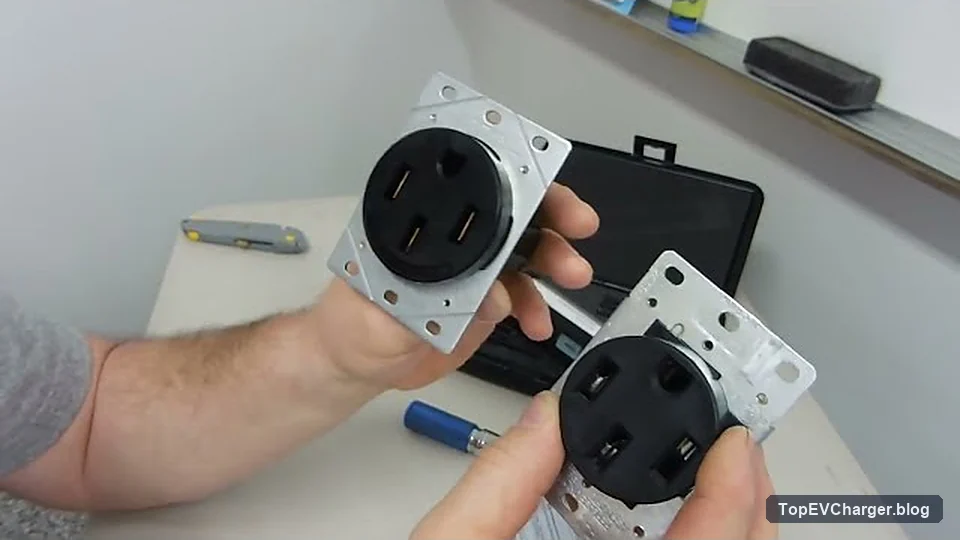
The popular NEMA 14-50 receptacle offers convenient plug-and-play flexibility for households. However, as explained in our guide on preventing oxidation on nema 14-50 outlet contacts, cheap outlets frequently fail under sustained high-amperage loads.
Standard commercial-grade outlets are engineered for intermittent RV usage rather than daily four-hour high-power vehicle charging sessions. Substandard installations risk localized melting, scorching, and severe residential fire hazards.
Industrial NEMA 14-50 receptacles experience mechanical spring-clip fatigue over thousands of insertion cycles, eventually leading to loose connections that rapidly accelerate contact resistance and thermal runaway during high-amperage vehicle charging.
Homeowners utilizing plug-in configurations must invest in high-grade industrial sockets rather than cheap RV variants to withstand the rigorous continuous thermal demands imposed by modern residential EV power supplies.
- NEMA 14-50 receptacles offer convenient plug-and-play setup flexibility.
- Commercial outlets often struggle with sustained daily vehicle charging.
- Substandard hardware risks localized melting and severe fire hazards.
- Spring-clip fatigue over insertion cycles
- Commercial-grade versus standard receptacle quality
Identifying Subpar Receptacle Hardware Risks
Installing industrial-grade heavy-duty receptacles is mandatory for safety when choosing plug-in charger configurations. Cheap hardware stores frequently stock residential-grade outlets unsuited for electric vehicle demands.
Homeowners must inspect plug seating tightness regularly to catch early signs of thermal discoloration or looseness.
- Industrial-grade heavy-duty receptacles are mandatory for safety.
- Cheap retail outlets lack the durability for electric vehicles.
- Regular visual inspections catch early signs of thermal stress.
Residential Service Panel Capacity and Load Management
Before installing any high-power charging setup, homeowners must evaluate total electrical service panel capacity. Many older homes operating on one-hundred-amp services require expensive electrical panel upgrades first.
Modern smart load management systems can dynamically throttle charging speeds when household appliance demand peaks simultaneously. This prevents costly main breaker trips and avoids total home power outages.
Evaluating total residential electrical service capacity is mandatory before installing high-output charging equipment, especially in older homes operating standard 200-amp panels that manage numerous heavy HVAC and kitchen appliances.
Dynamic load management systems monitor whole-home energy consumption in real time, automatically modulating charger output to prevent main service breaker trips when household electrical demand peaks during evening hours.
- Evaluating total electrical service panel capacity is essential.
- Older homes often require costly electrical panel upgrades first.
- Smart load management prevents costly main breaker trips safely.
- Main panel ampacity assessment
- Dynamic load management integration
Calculating Total Home Electrical Loads
Licensed electricians perform comprehensive load calculations accounting for HVAC units, electric ranges, and water heaters. Ensuring adequate headroom prevents overloading your primary residential electrical infrastructure.
Proper planning guarantees safe, uninterrupted power delivery for both your household appliances and your electric vehicle.
- Licensed electricians perform comprehensive home electrical load calculations.
- Adequate headroom prevents overloading primary residential infrastructure.
- Proper planning guarantees safe, uninterrupted daily power delivery.
Comprehensive Decision Framework for Home Charging Setups
Selecting between a plug-in receptacle and a hardwired connection ultimately depends on your lifestyle and vehicle needs. Renters benefit immensely from portable units, while homeowners prioritize maximum speed.
Weighing initial installation complexity against long-term reliability points most dedicated EV owners toward permanent hardwired solutions for peace of mind.
Selecting between hardwired and receptacle setups depends heavily on anticipated vehicle turnover, hardware relocation needs, and the specific thermal limitations of existing residential electrical infrastructure during continuous charging cycles.
Professional electricians should always evaluate service panel capacity, wire gauge integrity, and local code updates before finalizing an installation architecture that guarantees optimal safety, longevity, and everyday charging convenience.
- Lifestyle needs dictate your ideal residential charging configuration choice.
- Renters value portability while homeowners prioritize permanent speed.
- Long-term reliability favors direct hardwired installation methods.
- Hardware relocation flexibility factors
- Professional electrical infrastructure evaluation
Matching Your Setup to Driving Habits
Daily commuters needing rapid overnight turnarounds should always invest in professional hardwired installations. Low-mileage drivers might find sufficient convenience using a properly rated plug-in setup.
Consulting a certified local electrician ensures your final choice complies with all relevant regional codes.
- Daily commuters benefit most from fast hardwired charging speeds.
- Low-mileage drivers can utilize properly rated plug-in setups.
- Certified local electricians ensure full regional code compliance.
Frequently Asked Questions
Can a NEMA 14-50 outlet deliver a full 48-amp charge?
No, a NEMA 14-50 outlet is limited by code to a maximum continuous load of forty amps. Hardwired units are required to achieve full forty-eight-amp charging speeds safely.
Why do NEMA 14-50 outlets melt during EV charging?
Substandard residential-grade outlets cannot handle sustained high thermal stress over multiple hours. Industrial-grade hardware and proper torque installation are essential to prevent melting.
Is hardwiring an EV charger safer than using a plug?
Yes, hardwiring eliminates vulnerable spring-loaded mechanical plug interfaces entirely from the circuit. Direct screw connections significantly reduce electrical resistance and thermal failure risks.
Do I need a permit to install a 240-volt charging circuit?
Yes, local building codes almost always require electrical permits and professional inspections for safety. Permit compliance ensures your home insurance remains valid and installations meet standards.
Can I unplug a hardwired charger if I move homes?
Hardwired units are permanently attached to building wiring and require decommissioning by professionals. Portable chargers offer easier relocation if you plan on moving houses soon.