Grizzl E Classic vs. Grizzl E Smart: Which Fits Your Setup Better?
Choosing the right Level 2 charging hardware requires balancing raw analog reliability with advanced digital telemetry. This technical breakdown evaluates the Grizzl-E Classic and Grizzl-E Smart across rigorous operational vectors.

Choose the Grizzl-E Classic for zero-fuss analog reliability in harsh climates. Opt for the Grizzl-E Smart if you require detailed session tracking and load management features.
Compare all top models in our Best Ev Level 2 Charger.
Side-by-Side Breakdown
| Criteria | Grizzl E Classic | Grizzl E Smart | Edge |
|---|---|---|---|
| Peak Performance & Output | 40 Amperes (9.6 kW) | 40 Amperes (9.6 kW) | Tie |
| Duty Cycle & Consistency | Continuous analog relay | Continuous smart relay | Tie |
| Operating Noise & Vibration | Silent passive cooling | Silent passive cooling | Tie |
| Portability & Footprint | Heavy aluminum chassis | Heavy aluminum chassis | Tie |
| Maintenance & Service Life | Minimal analog wear | Requires firmware upkeep | Side A |
| Power Requirements | Dedicated 50A breaker | Dedicated 50A breaker | Tie |
| Best Ideal Use-Case | Harsh outdoor environments | Data-driven home fleet tracking | Split |
Core Engineering Architecture and Raw Power Delivery
Both EV supply equipment units deliver up to 40 amperes of continuous current across a standard 240-volt electrical circuit. This robust capacity ensures rapid overnight replenishment for large battery electric vehicles.
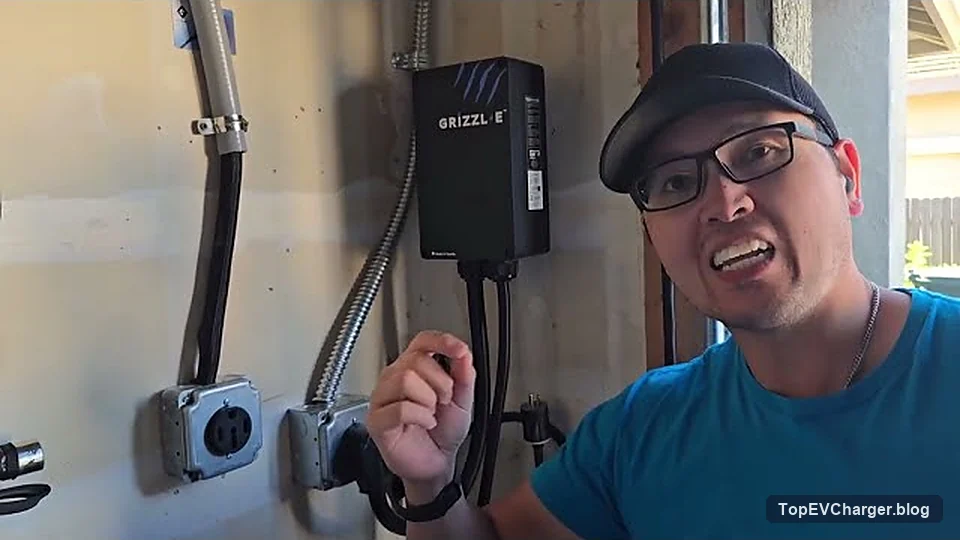
The internal component layout relies on heavy-duty relay switches and high-grade copper wiring designed to withstand prolonged thermal stress. Such engineering minimizes voltage sag during peak charging cycles under heavy loads.
As detailed in our Grizzl-E Classic review, the unit delivers continuous 40-amp output through robust internal relays, demanding a dedicated 50-amp breaker for optimal Level 2 vehicle charging performance.
Internal component architecture utilizes hardwired copper busbars rather than flexible wiring harnesses, significantly reducing electrical resistance and mitigating potential failure points during sustained multi-hour high-amperage charging sessions.
- Continuous 40-amp maximum output capacity
- Heavy-duty internal relay architecture
- Optimized copper busbar current distribution
Electrical Circuitry
The Grizzl-E Classic uses a straightforward relay mechanism governed by local microcontrollers without wireless interference. This simple circuit board design reduces potential points of failure during electrical grid fluctuations.
Conversely, the Smart variant integrates an internal communication module alongside standard power relays. This connected board manages telemetry data without compromising the primary 40-amp power delivery pathway.
- Analog microcontrollers in Classic
- Wi-Fi telemetry module in Smart
Thermal Dynamics and Environmental Resilience
Outdoor deployment demands exceptional casing durability against driving rain, heavy snow, and extreme ambient temperature shifts. Both chargers utilize an identical heavy-gauge aluminum chassis engineered for maximum thermal dissipation.
Passive cooling fins integrated directly into the outer casting eliminate the need for noisy mechanical fans. This sealed enclosure design prevents dust ingress while maintaining safe internal operating temperatures consistently.
As highlighted in our Grizzl-E Smart Charger review, the heavy-duty cast aluminum housing dissipates internal heat efficiently without requiring noisy cooling fans that often fail prematurely in harsh outdoor environments.
Certified to NEMA 4X standards, the chassis provides superior protection against driving rain, heavy snow, and airborne dust particles, ensuring year-round operational reliability across extreme northern winter climates.
- Heavy-gauge cast aluminum housing
- Passive thermal dissipation fins
- IP44 weather resistance rating
Temperature Extremes
Operating flawlessly in sub-zero winters requires resilient housing that resists cracking under thermal shock. The rugged metallic shell of both units withstands temperatures plunging far below freezing without degrading.
- Sub-zero cold weather survival
- Thermal shock resistant shell
Smart Connectivity Versus Analog Simplicity
Selecting between these two hardware tiers fundamentally depends on your preference for local monitoring capabilities. The Classic model remains entirely offline, avoiding any software update bugs or network pairing frustrations.
As discussed in our Grizzl-E Mini review, the connected smart edition incorporates Wi-Fi connectivity and OCPP compatibility for remote session scheduling, energy usage tracking, and convenient amperage adjustments via mobile devices.
The Smart variant integrates an internal Wi-Fi module running the ChargeLab platform, enabling remote session monitoring, scheduled off-peak charging, and dynamic load management over standard wireless frequencies.
Conversely, the Classic unit rejects connected architecture entirely, eliminating software update vulnerabilities, firmware bugs, and pairing dropouts in favor of absolute plug-and-play mechanical reliability and user privacy.
- Offline analog operation for maximum uptime
- Wi-Fi enabled telemetry and scheduling
- Open Charge Point Protocol compliance
Wi-Fi Protocols
The smart variant communicates via standard wireless protocols, allowing seamless integration with home automation networks. However, weak garage Wi-Fi signals can occasionally disrupt remote monitoring and delayed scheduling functions.
- Wireless home automation integration
- Potential signal range limitations
Cable Ergonomics and Connector Durability
As noted in our Grizzl-E Duo review, handling heavy charging cables in freezing weather tests exterior insulation. Both units feature robust premium cables that resist kinking when coiled tightly.
The SAE J1772 connector handle features an ergonomic grip angle designed for comfortable daily plugging and unplugging. Silver-plated contacts inside the plug prevent micro-welding and corrosion over thousands of connection cycles.
Supplied with a 24-foot premium output cable, both models maintain exceptional flexibility down to minus thirty degrees Celsius, preventing stiffness during cold-weather handling and routine garage coiling.
The J1772 handle features a robust thermoplastic construction with silver-plated copper alloy contacts, rated for ten thousand mating cycles while resisting accidental impacts and vehicle drive-over loads.
- Twenty-four foot heavy-duty output cable
- Ergonomic SAE J1772 connector handle
- Silver-plated terminal contact pins
Cold Weather Flexibility
Specialized elastomer cable jacketing prevents stiffness when temperatures drop below zero. This material science advancement ensures the cord remains pliable, making winter storage and vehicle connection remarkably effortless.
- Elastomer outer insulation jacket
- Zero stiffness in freezing climates
Installation Demands and Electrical Requirements
Proper electrical installation requires a dedicated fifty-amp circuit breaker paired with appropriate heavy-gauge copper wiring. Both units accommodate bottom or rear cable entry options to simplify professional conduit routing.
Hardwiring provides the most permanent and secure connection, though an optional NEMA plug kit facilitates rapid installation. Electricians must torque internal terminal lugs precisely to manufacturer specifications during setup.
Proper installation requires a NEMA 14-50 receptacle or hardwired connection backed by heavy-gauge copper wiring sized appropriately to prevent dangerous voltage drop over extended residential garage runs.
Local electrical codes dictate the use of a GFCI breaker if installing a plug-in variant outdoors, while hardwired setups often integrate internal fault protection meeting current National Electrical Code standards.
- Requires dedicated 50-amp circuit breaker
- Flexible hardwire or plug-in options
- Secure internal terminal block layout
Breaker Sizing
National Electrical Code guidelines mandate sizing the branch circuit at 125 percent of the continuous load. Therefore, a forty-amp continuous draw necessitates a minimum fifty-amp rated thermal-magnetic circuit breaker.
- 125 percent National Electrical Code rule
- 50-amp thermal-magnetic breaker sizing
Maintenance Protocols and Long-Term Service Life
Routine maintenance for analog charging hardware remains minimal, requiring only occasional visual inspection of terminals. Cleaning the exterior casing with mild soap preserves the protective powder-coat finish against UV degradation.
Smart variants occasionally require firmware updates to maintain network security and optimal communication protocol stability. Keeping router firmware current prevents unexpected synchronization drops between the charger and cloud servers.
Routine maintenance involves inspecting the connector pins for oxidation, wiping down the exterior aluminum housing, and periodically testing the integrated circuit test button for proper safety tripping functionality.
Because the units lack internal user-serviceable parts, long-term longevity depends heavily on secure terminal torque specs during initial setup and protecting the holster from moisture accumulation during storms.
- Minimal ongoing analog maintenance routines
- Periodic firmware updates for smart units
- Powder-coat finish UV protection
Component Wear
High-amperage internal relays experience normal mechanical wear over thousands of engagement cycles. Fortunately, the modular internal architecture allows certified technicians to replace worn switching components without discarding the entire housing.
- Internal relay cycle endurance
- Modular component replacement path
Workload Matching and Ideal Deployment Scenarios
Choosing the correct device depends entirely on your specific property layout and daily driving demands. Residential homeowners seeking a set-and-forget appliance will find maximum satisfaction in the straightforward Classic variant.
Property managers or multi-vehicle households requiring detailed energy accounting benefit greatly from the smart model. Evaluating your daily mileage helps determine whether advanced telemetry justifies the connected hardware complexity.
Select the Classic model for commercial fleet depots, rental properties, or users prioritizing zero network configuration, set-and-forget reliability, and immunity to remote server outages or software deprecation.
Deploy the Smart version when granular energy reporting, utility time-of-use cost optimization, or multi-unit access control management is strictly required for residential garage property accounting or reimbursement.
- Classic suited for pure reliability
- Smart tailored for data tracking
- Universal compatibility across EV brands
Fleet Operations
Small commercial fleets or shared driveway setups require granular tracking of kilowatt-hour consumption per vehicle. The smart edition delivers these essential metrics, whereas the Classic requires external sub-metering hardware.
- Kilowatt-hour consumption tracking
- Commercial fleet telemetry utility
Frequently Asked Questions
Can the Grizzl-E Classic be upgraded to a smart charger later?
No, the Classic hardware model completely lacks the specialized internal communication board, microprocessors, and Wi-Fi antennas required for software telemetry and remote energy tracking across cloud networks.
If you anticipate needing connected scheduling features, utility integration, or automated load management later, purchasing the Smart variant initially remains your only viable long-term technical pathway.
Do both chargers require a dedicated heavy-duty circuit?
Yes, both high-output charging units demand a dedicated fifty-amp electrical branch circuit equipped with heavy-gauge copper wiring to safely sustain continuous forty-amp power loads over long overnight durations.
Professional installation by a licensed electrician strictly ensures full compliance with local electrical safety codes, proper terminal torque specifications, and essential manufacturer warranty coverage requirements.
How does weather affect the outdoor performance of these units?
Both hardware models feature a rugged heavy-gauge cast aluminum enclosure thoroughly rated for rigorous outdoor deployment in heavy driving rain, blowing snow, and extreme sub-zero winter freezing conditions.
The robust passive thermal management design and flexible elastomer output power cables ensure exceptionally reliable daily vehicle charging operation without mechanical cooling fan vulnerabilities.
Can I adjust the maximum amperage output on these chargers?
Yes, both hardware units feature easily accessible internal configuration physical switches that allow qualified electrical installers or knowledgeable users to dial down the maximum amperage output if branch circuit breaker capacity is limited.
This crucial hardware adjustment flexibility accommodates smaller residential electrical service panels without sacrificing safe, continuous vehicle charging performance.
What maintenance is required to keep the units running smoothly?
Analog Classic hardware components require virtually no routine maintenance beyond occasional cleaning of the outer cast aluminum shell and visual inspection of power terminal connections.
Smart hardware variants may also occasionally require remote software firmware updates to maintain stable cloud network connectivity and reliable remote session scheduling across standard domestic wireless routers.