Chargepoint Nema 14 50 vs 6 50: Which Receptacle Fits Your Garage?
Selecting the right 50-amp outlet requires understanding grounding and neutral requirements. This technical guide compares NEMA 14-50 and 6-50 receptacles for residential EV charging.


The NEMA 14-50 wins for modern smart chargers requiring a neutral wire, while the NEMA 6-50 suits traditional welder-style dedicated heavy-duty circuits.
Compare all top models in our Best Ev Level 2 Charger.
Side-by-Side Breakdown
| Criteria | Chargepoint Nema 14 50 | 6 50 | Edge |
|---|---|---|---|
| Peak Performance & Output | Supports up to 50 amps continuous load safely. | Handles 50 amps continuous load reliably. | Tie |
| Duty Cycle & Consistency | Maintains thermal stability under sustained charging. | Designed for heavy industrial welding duty cycles. | NEMA 6-50 |
| Operating Noise & Vibration | Silent passive operation with zero mechanical hum. | Completely silent solid-state connection interface. | Tie |
| Portability & Footprint | Requires a larger four-slot enclosure box. | Compact three-slot surface mount configuration. | NEMA 6-50 |
| Maintenance & Service Life | Requires periodic terminal torque verification checks. | Fewer contact points reduce potential oxidation risks. | NEMA 6-50 |
| Power Requirements | Demands hot-hot-neutral-ground four-wire cabling. | Requires simpler hot-hot-ground three-wire runs. | NEMA 6-50 |
| Best Ideal Use-Case | Smart hardwired or plug-in EVSE installations. | Legacy garage setups and heavy-duty welders. | NEMA 14-50 |
An Engineering Overview of 50-Amp EV Receptacles
Choosing between different 50-amp electrical outlets involves critical safety and wiring decisions. Residential EV charging demands continuous high-amperage power delivery without thermal overload.
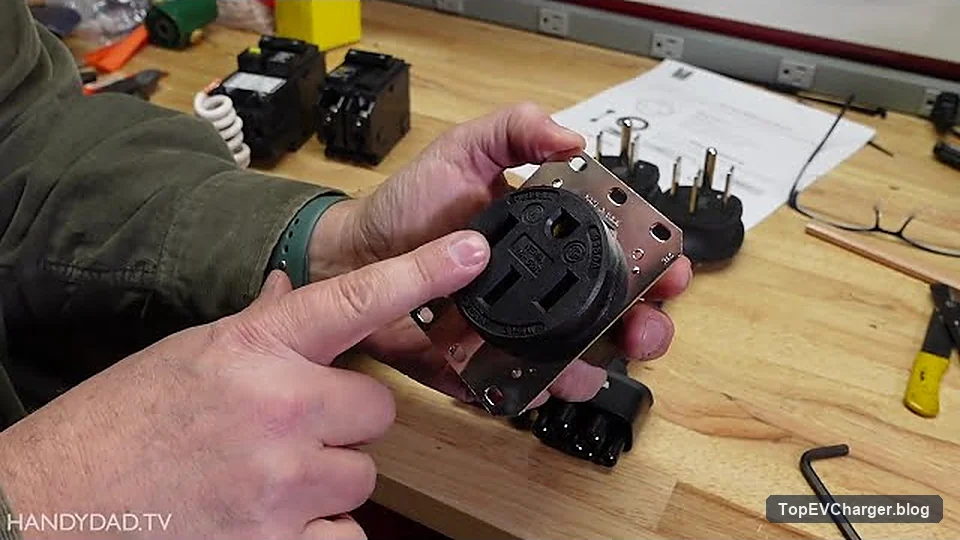
Understanding the physical pin configurations prevents costly electrical installation errors. Both receptacles supply fifty amps, but internal conductor paths differ significantly.
Evaluating units like our Chargepoint Home Flex NEMA 14-50 review reveals how well modern hardware handles 50-amp continuous loads at 240 volts nominal without thermal throttling.
Understanding their internal physical architecture helps electricians select proper hardware. While both support heavy loads, their grounding methodologies and pin configurations diverge significantly based on National Electrical Code safety mandates.
- Both outlets support 50-amp continuous loads under the NEC.
- Internal pin configurations dictate distinct cable assembly requirements.
- Thermal management remains critical for extended overnight charging sessions.
Core Electrical Architecture
The primary distinction lies in internal conductor counts. Proper wire gauge selection ensures your garage handles continuous electrical demands safely.
- Four-wire versus three-wire distribution paths.
- Conductor gauge sizing for long garage runs.
Pinout Variations and Conductor Design Differences
The neutral conductor represents the core structural divergence between these two receptacles. A NEMA 14-50 includes a dedicated neutral pin alongside two hot wires and one ground.
Conversely, the NEMA 6-50 features two hot wires and one ground wire without any neutral connection. This missing neutral changes how smart chargers draw auxiliary control power.
The NEMA 14-50 configuration features four distinct prongs, including two hot conductors, a neutral wire, and a dedicated equipment ground. This layout supports split-phase loads requiring separate neutral paths.
Conversely, the NEMA 6-50 utilizes a three-prong layout comprising two hot wires and one grounding conductor. Readers evaluating alternative hardware can consult our Emporia Level 2 EV charger review for split-phase specifics.
- NEMA 14-50 utilizes four distinct current-carrying and grounding paths.
- NEMA 6-50 omits the neutral wire entirely for a three-conductor setup.
- Auxiliary internal components in smart chargers often require 120-volt feeds.
Why the Neutral Conductor Matters
Many modern smart EV chargers step down voltage internally using the neutral line. Without a neutral wire present, advanced telemetry features may fail to function.
- Smart displays and Wi-Fi modules frequently rely on 120-volt circuits.
- Improper makeshift neutral bridging violates national electrical safety codes.
Installation Costs and Wiring Complexity Breakdown
Installing a NEMA 14-50 circuit typically incurs higher material costs due to the extra conductor. As noted in our Chargepoint Home Flex review, running heavy copper wire requires robust conduit paths.
A NEMA 6-50 circuit often proves cheaper to install because you pull one less wire through the conduit. Material savings on copper add up quickly over long distances.
Installing a NEMA 14-50 circuit typically demands four-conductor copper cabling, which increases material expenses. Electricians must pull 6 AWG copper through conduit, driving up labor time during residential garage retrofits.
A NEMA 6-50 installation requires simpler three-wire runs, reducing overall material costs. However, finding chargers equipped with factory-fitted 6-50 plugs can limit hardware options compared to the ubiquitous 14-50 standard.
- Four-conductor cabling increases total home electrical project expenses.
- Three-conductor runs simplify panel connections and conduit sizing.
- Labor hours remain comparable for both standard garage outlet drops.
Conduit and Breaker Panel Economics
Double-pole fifty-amp breakers are mandatory for both outlet types in your main panel. Conduit fill capacity calculations favor the simpler three-wire setup.
- Standard double-pole 50A breakers protect both configurations.
- Conduit crowding is minimized with the slimmer 6-50 cable bundle.
Why Direct Plug-In Conversion Risks Overheating
Homeowners often assume they can use cheap plug adapters to bridge the gap between outlets. You should also review our guide on preventing NEMA 14-50 outlet oxidation to maintain safe connection resistance over time.
Using improper third-party adapters can bypass internal safety monitoring systems. Always match your portable charger plug directly to the installed wall receptacle.
Attempting to use aftermarket plug adapters between mismatched configurations creates severe safety hazards. High-resistance connections generate localized heat, rapidly melting terminal blocks and degrading outlet spring tension under maximum load.
Continuous 40-amp draw exposes any microscopic imperfection in terminal torque. Professional installers always match the EVSE whip directly to the wall receptacle, avoiding adapter thermal fatigue that triggers residential electrical fires.
- Adapters cannot magically generate a missing neutral connection safely.
- Mismatched pins risk thermal runaway and catastrophic equipment damage.
- Manufacturer warranties often become void when using unauthorized plug converters.
Recognizing Adapter Hazards
Unlisted adapters lack proper UL certification for continuous high-amperage vehicle charging. High resistance joints inside cheap adapters generate extreme localized heat.
- Thermal hotspots melt plastic receptacle housings rapidly.
- Uncertified components invalidate local residential electrical inspection approvals.
Safety Standards, NEC Compliance, and Thermal Management
The National Electrical Code enforces strict guidelines regarding garage circuit protection. Ground fault circuit interrupter breakers are now widely required for residential EV installations.
Proper terminal torque during installation prevents high-resistance connections. Using industrial-grade receptacles rather than cheap builder-grade outlets prevents premature melting failures.
Modern electrical standards mandate GFCI protection for all garage-installed 240-volt receptacles. This requirement adds significant cost to NEMA 14-50 and 6-50 breakers while ensuring immediate circuit interruption during ground faults.
Thermal imaging studies show that industrial-grade receptacles outperform standard residential outlets. Using high-grade copper alloy contacts prevents excessive temperature spikes during multi-hour charging sessions in warm garages.
- NEC mandates GFCI protection for indoor and outdoor garage receptacles.
- Industrial-grade copper alloy contacts resist thermal fatigue over time.
- Routine visual inspections catch discoloration before component failure occurs.
Preventing Receptacle Melting
Continuous 40-amp loads strain low-quality terminals significantly during multi-hour charging sessions. Upgrading to heavy-duty commercial outlets safeguards your home electrical infrastructure.
- Commercial receptacles feature reinforced spring-clip internal contacts.
- Torque screwdrivers ensure manufacturer specifications are strictly met.
Choosing the Right 50-Amp Receptacle for Your EV Setup
Select the NEMA 14-50 if you plan to use versatile smart portable EV chargers. Most modern dual-voltage chargers utilize this specific four-pin plug format.
Choose the NEMA 6-50 if your garage already features existing heavy-duty welder wiring. Always evaluate your vehicle's specific charging requirements before hiring an electrician.
Selecting the ideal receptacle depends on your specific hardware and wiring layout. If your charger requires a neutral line, the NEMA 14-50 remains the definitive industry choice for maximum flexibility.
Properties featuring dedicated three-wire runs can safely utilize the simpler NEMA 6-50 design. Always verify local jurisdiction codes before finalizing your residential garage charging infrastructure installation plans.
- Verify your exact portable EVSE manufacturer plug specifications first.
- Consult a licensed electrician to evaluate your existing panel capacity.
- Prioritize future-proof four-wire installations for maximum equipment compatibility.
Making Your Final Garage Decision
Investing in the correct receptacle format prevents expensive rewiring down the road. Proper planning ensures seamless daily charging without thermal bottlenecks.
- Evaluate long-term vehicle upgrade plans before running wires.
- Balance initial material savings against future equipment flexibility.
Frequently Asked Questions
Can I plug a NEMA 14-50 charger into a 6-50 outlet using an adapter?
You should never use unverified adapters to bridge these outlets because missing neutral lines can cause equipment malfunction or severe electrical fire hazards.
Which receptacle is cheaper to install by an electrician?
The NEMA 6-50 is usually cheaper because it requires running a three-conductor cable instead of the more expensive four-conductor wire needed for the 14-50.
Do both outlets deliver the exact same charging speed?
Yes, both receptacles support fifty-amp circuits delivering up to forty continuous amps of power, resulting in identical vehicle charging speeds.
Why do modern smart EV chargers prefer the NEMA 14-50?
Smart chargers often rely on the dedicated neutral wire to power internal Wi-Fi radios, displays, and auxiliary control transformers safely.
Are GFCI breakers required for both NEMA 14-50 and 6-50 outlets?
Modern electrical codes mandate GFCI protection for garage-installed receptacles to prevent severe shock hazards during daily residential vehicle charging sessions.